
Road Freight, Industrial Transport, Abnormal-Load Transport and International Logistics with KALTRUCKS France
Switzerland holds a unique position at the heart of Europe. Located at the crossroads of Europe’s main trade routes, it is a major economic partner for France, Germany, Italy, Austria and the rest of the continent.
Every day, thousands of tonnes of goods cross the Swiss borders. Industrial machinery, medical equipment, manufactured goods, agricultural machinery, construction equipment and high-technology components are continuously transported between Switzerland and neighbouring countries.
However, transporting goods to Switzerland is not exactly the same as carrying out a standard transport operation within the European Union.
Switzerland has its own regulations, customs procedures and specific logistical constraints, which require in-depth expertise in international transport.
At KALTRUCKS France, we organise daily transport operations to and from Switzerland for industrial companies, construction businesses, manufacturers, agricultural operators and international groups.
Thanks to our expertise in European road freight and our knowledge of Swiss customs procedures, we provide reliable, fast and secure solutions for all types of goods.
🌍 Why Is Switzerland a Strategic Market in Europe?
Despite its relatively small size, Switzerland has one of the strongest economies in the world.
The country is recognised for:
- its precision engineering industry;
- its pharmaceutical sector;
- its mechanical engineering industry;
- its expertise in watchmaking;
- its financial sector;
- its technological innovation.
Switzerland maintains extremely strong trade relationships with its European neighbours.
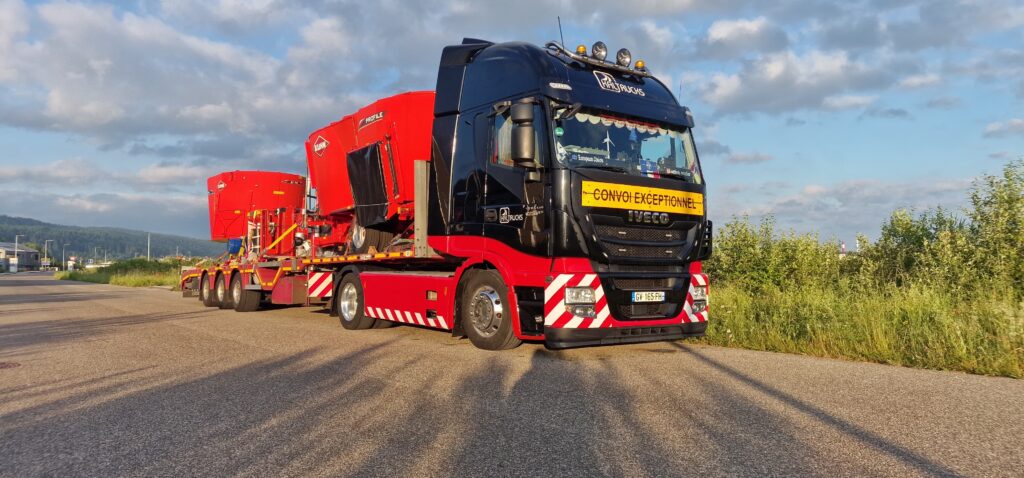
For many French, German and Italian companies, the Swiss market represents:
- a major commercial outlet;
- a strategic industrial partner;
- a supplier of high-value products.
This economic activity naturally generates significant logistics requirements.
📍 An Exceptional Geographical Position
Switzerland benefits from a unique location.
Situated between:
- France;
- Germany;
- Italy;
- Austria;
it forms a genuine European logistics hub.
Major European transport corridors regularly cross Swiss territory, particularly through:
- Basel;
- Zurich;
- Geneva;
- Lausanne;
- Bern;
- Lugano.
This geographical position encourages international trade, but it also requires the rigorous management of freight flows.
🚛 How Does Transport to Switzerland Work?
Many companies assume that transporting goods to Switzerland works exactly like transport between two European Union countries.
In reality, the situation is slightly different.
Switzerland is not a member of the European Union.
This means that goods are generally subject to specific customs formalities.
This particular requirement calls for:
- rigorous document preparation;
- full knowledge of administrative procedures;
- excellent logistical coordination.
At KALTRUCKS France, we support our customers throughout these procedures in order to simplify their transport operations.
📦 Customs Formalities: An Essential Step
One of the most important aspects of transport to Switzerland is the management of customs formalities.
Unlike intra-EU freight flows, goods must be declared when crossing the border.
The required documents vary depending on:
- the nature of the goods;
- their origin;
- their destination;
- the customs procedure being used.
Poor preparation can result in:
❌ delays;
❌ additional inspections;
❌ unexpected costs.
This is why the carrier’s experience plays an essential role.
🚚 Curtainsider Transport to Switzerland
Curtainsider transport remains one of the most commonly used solutions for freight movements between Switzerland and the rest of Europe.
This versatile trailer allows:
- side loading;
- rear loading;
- loading from above.
It is perfectly suitable for:
- pallets;
- manufactured goods;
- industrial components;
- technical equipment;
- general cargo.
Industrial companies particularly value its flexibility.
🏭 Switzerland and European Industry
Switzerland has a highly developed industrial sector.
European companies export the following goods to Switzerland on a daily basis:
- mechanical components;
- industrial equipment;
- machine tools;
- electronic components;
- medical equipment.
Swiss industrial companies also regularly ship their products throughout Europe.
The intensity of these trade flows makes industrial transport a particularly dynamic sector.
⚙️ Industrial Transport to Switzerland
At KALTRUCKS France, we regularly organise industrial transport operations between Switzerland and the rest of Europe.
We transport, in particular:
- production machinery;
- technical equipment;
- industrial production lines;
- metal structures;
- industrial modules.
Each operation requires:
- a technical assessment;
- logistical planning;
- sometimes, specific handling equipment.
🚜 Transporting Agricultural Machinery to Switzerland
Agriculture remains an important sector in Switzerland despite the country’s geographical constraints.
Agricultural operators regularly invest in:
- tractors;
- combine harvesters;
- sprayers;
- harvesting equipment.
The European agricultural machinery market therefore generates numerous transport operations between Switzerland and its neighbouring countries.
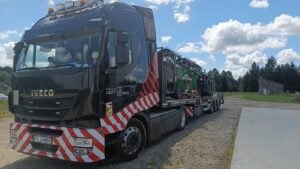


We regularly organise the delivery of new and used agricultural machinery throughout Switzerland.
🏗 Transporting Construction Machinery to Switzerland
The Swiss construction and civil engineering sector is particularly active.
Infrastructure projects, urban construction sites and industrial developments require a continuous supply of equipment.
We regularly transport:
- excavators;
- wheel loaders;
- bulldozers;
- aerial work platforms;
- compactors;
- quarrying equipment.
These operations often require specialised trailers.
🚨 Abnormal-Load Transport in Switzerland
Switzerland applies particularly strict regulations to abnormal-load transport.
When goods exceed:
- certain width limits;
- certain height limits;
- certain weight limits;
the transport operation requires specific permits.
Abnormal-load convoys may require:
- route surveys;
- compulsory travelling times;
- pilot cars;
- cantonal permits.
Careful project preparation is therefore essential.
🏔 The Challenges of Transporting Goods Through the Alps
One of the main characteristics of transport in Switzerland is the country’s geography.
The Alps have a significant impact on logistics routes.
Several constraints must be taken into consideration:
- tunnels;
- mountain passes;
- height restrictions;
- seasonal restrictions;
- weather conditions.
This environment requires extensive knowledge of the road network and local conditions.
Routes may sometimes need to be adapted in order to ensure the safety of the transport operation.
🚛 Main Areas Served in Switzerland
Our teams operate throughout Switzerland.
We regularly serve:
📍 Geneva
📍 Lausanne
📍 Fribourg
📍 Bern
📍 Zurich
📍 Basel
📍 Lucerne
📍 Lugano
📍 St. Gallen
This nationwide coverage allows us to support both SMEs and major industrial groups.
🌍 Switzerland ⇄ France Transport
France remains one of Switzerland’s main trading partners.
Freight flows include:
- industrial goods;
- pharmaceutical products;
- construction equipment;
- manufactured goods;
- agricultural machinery.
The main routes notably pass through:
- Geneva;
- Basel;
- Lausanne;
- the Grand Est region;
- the Auvergne-Rhône-Alpes region.
These freight flows represent a significant part of our business.
🌍 Switzerland ⇄ Germany Transport
Germany is also a major trading partner.
Numerous industrial freight routes connect:
- Zurich;
- Basel;
- Bern;
with Germany’s main industrial centres.
Technical equipment and industrial machinery account for a significant proportion of these trade flows.
🌍 Switzerland ⇄ Italy Transport
Switzerland’s proximity to Italy also generates a considerable volume of transport operations.
These freight flows mainly involve:
- industrial products;
- construction materials;
- mechanical equipment;
- general cargo.
Alpine crossings play a strategic role on these routes.
⏱ What Are the Transit Times to Switzerland?
Transit times depend on:
- the loading location;
- the destination;
- the customs formalities;
- the type of goods.
As a general indication:
| Route | Average Transit Time |
|---|---|
| France → Geneva | 24 hours |
| Lyon → Zurich | 24 to 48 hours |
| Paris → Bern | 48 hours |
| Germany → Zurich | 24 to 48 hours |
| Italy → Lugano | 24 hours |
Express transport solutions are also available for urgent shipments.
🔒 Cargo Tracking and Security
Today, companies expect to be able to track their shipments in real time.
Our solutions include:
- GPS tracking;
- live vehicle location;
- complete traceability;
- continuous communication.
This transparency improves the quality of the service and provides reassurance to our customers.
👨✈️ Essential Expertise for Transport to Switzerland
Transport operations to Switzerland require:
- customs expertise;
- regulatory knowledge;
- experience in international transport.
Our teams handle these freight flows on a daily basis and support customers throughout every stage of their logistics projects.
💰 How Much Does Transport to Switzerland Cost?
The cost depends on:
- the distance;
- the weight;
- the volume;
- the type of goods;
- the customs formalities.
As a general indication:
👉 Standard transport: between €1.40 and €2.50/km.
👉 Industrial transport: personalised quotation.
👉 Abnormal-load transport: specific assessment based on the dimensions.
Every transport operation is subject to a detailed assessment.
📈 Why Will Switzerland Remain a Strategic Logistics Market?
Switzerland continues to benefit from a very strong economy and a highly developed industrial network.
Trade with the rest of Europe will continue to grow thanks to:
- innovation;
- precision engineering;
- medical technologies;
- industrial investment.
The demand for reliable logistics solutions will therefore remain particularly significant in the coming years.
🚛 Why Choose KALTRUCKS France for Your Transport Operations to Switzerland?
Our teams provide daily support to:
🏭 industrial companies;
🚜 agricultural operators;
🏗 construction and civil engineering companies;
⚙️ manufacturers;
📦 distributors;
with their transport projects between Switzerland and the rest of Europe.
Our customers primarily require:
✅ security;
✅ responsiveness;
✅ customs expertise;
✅ compliance with delivery times;
✅ international transport expertise.
📞 Do You Need a Quotation for Transport to Switzerland?
Are you looking for a reliable solution to transport:
🚚 general cargo;
🏭 industrial equipment;
🚜 agricultural machinery;
🏗 construction machinery;
🚨 oversized loads;
between Switzerland and the rest of Europe?
The KALTRUCKS France team will assess your project free of charge and propose a solution adapted to your technical and budgetary requirements.
📞 +33 6 22 49 72 28
📧 info@kaltrucks.com
🌐 www.kaltrucks.com
👉 Request your personalized quote today for transport operations between Switzerland and Europe.
