
Road, oversized, industrial and logistics transport between France and Germany with KALTRUCKS France
France and Germany have maintained one of the most important trade relationships in Europe for several decades. Every day, thousands of trucks cross the border carrying industrial goods, technical equipment, raw materials, construction machinery and agricultural equipment.
For many companies, the German market is an essential partner. Conversely, many German manufacturers work with French customers on a daily basis.
In this context, France ⇄ Germany transport plays a strategic role in the functioning of the European economy.
At KALTRUCKS France, we organise daily transport operations between France and Germany, for general goods as well as industrial transport, oversized transport and complex logistics operations.
🇫🇷 🇩🇪 Why is the France – Germany corridor so important?
Germany has long been France’s leading trading partner.
Thousands of companies exchange the following goods every day:
- industrial parts,
- mechanical equipment,
- manufactured products,
- construction materials,
- agricultural machinery,
- construction equipment,
- and products intended for the automotive, chemical and energy sectors.
This intensity of trade explains why transport between the two countries has become an extremely dynamic market.
Each region has its own economic characteristics.
On the German side, the main industrial centres are located around:
- Stuttgart,
- Munich,
- Frankfurt,
- Cologne,
- Düsseldorf,
- Hamburg,
- Leipzig
In France, flows particularly concern:
- Île-de-France,
- Hauts-de-France,
- Grand Est,
- the Lyon region,
- Pays de la Loire,
- Nouvelle-Aquitaine.
🌍 An essential logistics corridor for European industry
When looking at freight flows in Europe, the France ⇄ Germany corridor stands out as one of the most strategic on the continent.
The automotive industry is probably the clearest example.
The same part may be:
- produced in Germany,
- processed in France,
- then integrated into a factory located in another European country.
Modern supply chains therefore require:
- high reliability,
- controlled transit times,
- and perfect coordination between the various transport stakeholders.
Even the slightest supply disruption can have major consequences for production.
🚛 What types of transport do we carry out between France and Germany?
Trade between the two countries involves a very wide variety of goods.
At KALTRUCKS France, we notably provide:
🚚 Tautliner transport
Tautliner transport remains the most commonly used solution for general goods.
This type of trailer allows:
- side loading,
- roof loading,
- and great flexibility for industrial companies.
It is perfectly suited to transporting:
- pallets,
- manufactured products,
- industrial equipment,
- and full loads.
🏗 Industrial transport
The industrial sector represents a significant share of transport flows between France and Germany.
We regularly transport:
- machine tools,
- presses,
- production lines,
- technical equipment,
- and machinery intended for factories.
Industrial companies are primarily looking for:
- safety,
- punctuality,
- and full control of logistics operations.
🚜 Agricultural transport
Germany is one of Europe’s largest markets for agricultural machinery.
Many French farms regularly purchase:
- tractors,
- combine harvesters,
- sprayers,
- or specialised equipment from Germany.
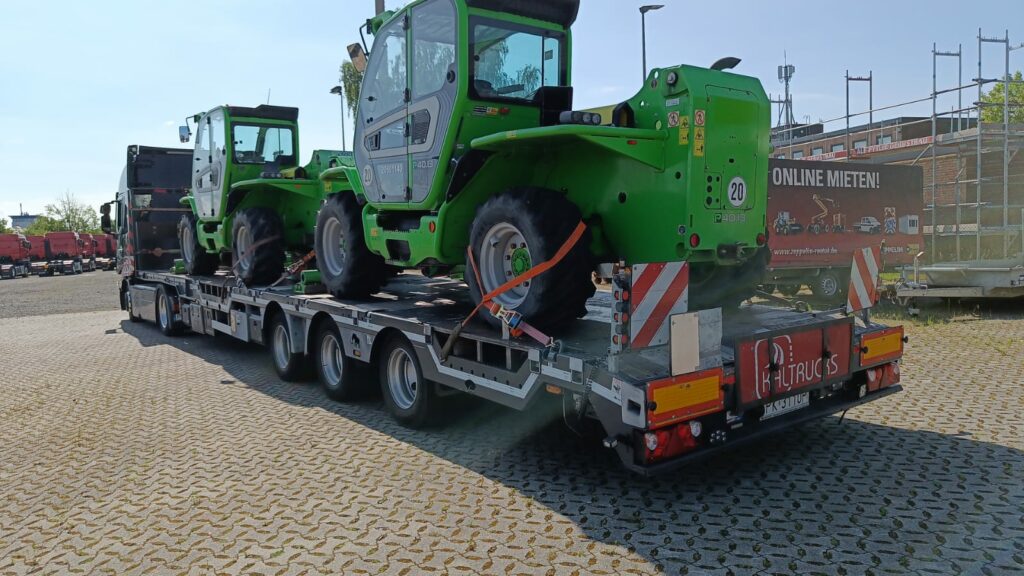
The second-hand market also generates a significant volume of transport operations.
🚧 Construction equipment transport
The construction and public works sector also generates many transport flows.
We regularly transport:
- excavators,
- bulldozers,
- loaders,
- compactors,
- and heavy construction equipment.
These operations often require specialised machinery transport trailers or heavy equipment trailers.
🚨 Oversized transport between France and Germany
Some goods exceed the dimensions permitted for standard transport.
This is particularly the case for:
- industrial machinery,
- steel structures,
- energy equipment,
- oversized agricultural machinery.
In these situations, the transport becomes oversized.
Oversized transport operations generally require:
- administrative permits,
- route studies,
- specific schedules,
- and sometimes escort vehicles.
Coordination between French and German regulations requires genuine expertise.
📍 Main logistics routes between France and Germany
The geographical proximity of the two countries allows for relatively short transit times.
The main corridors include:
Strasbourg – Karlsruhe
Probably one of the most frequently used routes.
It directly connects the French Grand Est region with Germany’s industrial areas.
Metz – Saarbrücken
Widely used for industrial and steel-industry flows.
Mulhouse – Freiburg
Particularly strategic for trade with southern Germany and Switzerland.
Lille – Ruhr
An important corridor for trade between northern France and Germany’s Ruhr industrial region.
These corridors account for a significant share of European traffic.
⏱ What are the transit times between France and Germany?
Transit times mainly depend on:
- the loading location,
- the delivery location,
- the type of goods,
- and regulatory constraints.
As an indication:
| RouteAverage transit time | |
|---|---|
| Eastern France → Western Germany | 24h |
| Paris → Frankfurt | 24 to 48h |
| Lyon → Munich | 48h |
| Nantes → Hamburg | 48 to 72h |
| Bordeaux → Berlin | 72h |
For urgent transport operations, double-driver solutions can considerably reduce transit times.
🚛 Express transport France ⇄ Germany
Some industries cannot wait several days.
When a production line is at a standstill or when an urgent delivery must be completed, express transport becomes essential.
At KALTRUCKS France, we offer:
- dedicated vehicles,
- urgent transport,
- and double-driver solutions.
This organisation makes it possible to:
- reduce downtime,
- secure supply chains,
- and meet the most demanding deadlines.
📦 Groupage transport between France and Germany
Not every company needs a full truckload.
Many shipments involve only a few pallets or a few tonnes of goods.
In these situations, groupage is a particularly attractive solution.
It allows companies to:
- share transport costs,
- reduce transport budgets,
- and optimise logistics flows.
This solution is particularly suitable for:
- SMEs,
- manufacturers,
- and distributors.
🔒 Safety and traceability
Goods transported between France and Germany often represent significant value.
Industrial companies now expect:
- full visibility,
- real-time tracking,
- and maximum security.
Our vehicles are equipped with solutions providing:
- GPS tracking,
- geolocation,
- and continuous communication with operational teams.
This transparency reassures customers throughout the transport operation.
👨✈️ Drivers specialised in France–Germany transport flows
International transport cannot be improvised.
Knowledge of:
- regulations,
- logistics corridors,
- industrial areas,
- and local procedures,
is a genuine advantage.
At KALTRUCKS France, our drivers regularly operate on the main France–Germany routes.
This experience allows for:
- better anticipation,
- fewer unexpected issues,
- and greater reliability.
💰 How much does transport between France and Germany cost?
The price mainly depends on:
- the distance,
- the type of goods,
- the vehicle used,
- and the level of urgency.
As an indication:
👉 Standard tautliner transport: between €1.20 and €2.20/km
👉 Dedicated express transport: between €1.80 and €3/km
👉 Oversized transport: specific quotation depending on dimensions and permits.
Groupage solutions can often significantly reduce the overall cost.
📈 Why does Germany remain a strategic market for French companies?
Beyond transport itself, Germany represents a major market for French exporters.
Its geographical proximity, industrial strength and economic stability explain why so many companies are developing their business in Germany.
This dynamic generates constant demand for:
- road transport,
- industrial logistics,
- oversized transport,
- and express solutions.
Growth prospects remain very positive for the coming years.
🚛 Why choose KALTRUCKS France for your France ⇄ Germany transport operations?
For several years, KALTRUCKS France has supported industrial companies, construction businesses, manufacturers and agricultural operators across the entire France–Germany corridor.
Our customers are primarily looking for:
✅ high responsiveness
✅ full control of logistics operations
✅ expertise in European transport
✅ solutions adapted to heavy and oversized loads
✅ a single point of contact
Our knowledge of the German market is a genuine advantage in securing your logistics operations.
📞 Need a quote for transport between France and Germany?
Are you looking for a reliable partner for your:
🚚 industrial transport
🚜 agricultural transport
🏗 construction transport
⚙️ oversized transport
📦 general goods
between France and Germany?
The KALTRUCKS France team will assess your project free of charge and offer a solution tailored to your technical and budgetary requirements.
📞 +33 6 22 49 72 28
📧 info@kaltrucks.com
🌐 www.kaltrucks.com
👉 Request your personalised quote today for your France ⇄ Germany transport operations.